
The Synaptic Blueprint: Zinc as Molecular Glue for Shank3
Blog post description.
5/30/20263 min read
I am deeply grateful to the Autism Research Institute (ARI) for hosting these invaluable educational webinars, and to Professor Andreas Grabrucker, PhD, for enlightening the community with his groundbreaking research. This post reflects my personal notes, core takeaways, and reflections from his presentation. To explore this research in its full, definitive depth, I highly encourage readers to visit the Autism Research Institute and support their work.
For decades, the search for the root drivers of autism has felt like a tug-of-war between two seemingly separate forces: the rigid blueprints of genetics and the unpredictable influence of our environment. We are often presented with a fragmented picture—a list of over 1,000 risk-associated genes on one hand, and a nebulous collection of environmental factors on the other.
But what if these disparate factors converge on a single, hidden biological bottleneck?
Enter Professor Andreas Grabrucker, PhD (Bernal Institute). By viewing zinc as more than just a passive micronutrient, his research invites us to see it as a master signaling ion—the structural architect of the developing brain.
The Synaptic Blueprint: Zinc as Molecular Glue for Shank3
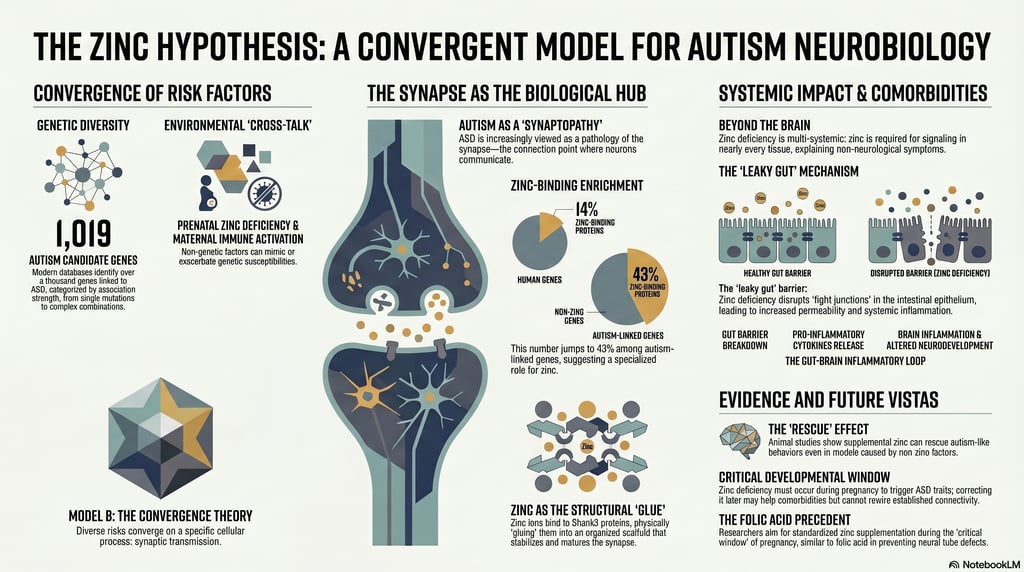
In neurobiology, the synapse is the microscopic junction where neurons communicate. For these signals to pass through cleanly, the post-synaptic density requires an incredibly stable protein framework. At the center of this construction project are Shank proteins (particularly Shank3), which act as the physical scaffolding anchoring neurotransmitter receptors in place.
Dr. Grabrucker’s research highlights a profound, direct relationship between zinc and Shank3:
The Signaling Ion: In roughly 80% of glutamatergic synapses, zinc is stored in vesicles and released alongside glutamate during neural activity.
The Structural Bridge: Once released, zinc travels to the post-synapse and docks specifically at the tail end (the SAM domain) of the Shank protein.
The "Glue" Effect: Without zinc, Shank proteins appear under an electron microscope as a disorganized, random mesh. When zinc is introduced, it acts as a physical glue, triggering these proteins to align in a rigid, parallel platform necessary for mature, functional neurotransmission.
The Bottleneck: If a developing system suffers from a severe zinc deficiency, the Shank3 tail cannot bind properly. This means a nutritional deficiency can functionally mimic a genetic Shank3 mutation—resulting in the altered neural connectivity and behavioral phenotypes associated with autism.
Convergence in the SFARI Gene Bank
The most startling evidence for this hypothesis lies in our genetic code. If zinc were a mere bystander, zinc-binding proteins would appear in autism-linked genes at the same rate as the general population. Data from the SFARI (Simons Foundation Autism Research Initiative) gene bank tells a different story:
Gene Pool Percentage of Zinc-Binding Proteins General Human Genome~14%Autism-Linked Genes (~1,900 genes)43%Category 1 Genes (High-Risk/Direct Mutation)Over 50%
This strongly suggests a model of biological convergence. Instead of 1,000 separate causes for autism, diverse genetic mutations and environmental stressors (such as maternal infection) may all funnel into a single bottleneck: the disruption of zinc-dependent synaptic maturation.
The Gut-Brain Loop: A Systemic Breakdown
Autism is traditionally characterized as a brain pathology, yet a vast majority of individuals suffer from severe gastrointestinal (GI) issues. Dr. Grabrucker argues these are not side effects, but components of the same systemic metabolic pathway.
Using 3D human intestinal organoids, his team found that zinc deficiency alone disrupts "tight junctions"—the cellular seals of the gut lining. This breakdown leads to a "Leaky Gut," allowing pro-inflammatory signaling proteins (cytokines) to escape into the bloodstream. These cytokines cross the blood-brain barrier, triggering neuro-inflammation and altering astrocyte activity. What began as a metabolic gut issue ultimately manifests as a behavioral brain issue.
The Critical Window of Plasticity
Can we simply fix the wiring with a supplement at any age? Dr. Grabrucker emphasizes a strict distinction between the developing brain and the adult brain:
Prenatal Development: During early development, the brain is in a state of high plasticity. A lack of zinc during this critical window permanently alters how the neural architecture is wired.
Adulthood: In adults, core neural connectivity is already fixed. While an adult zinc deficiency can cause cognitive defects, lethargy, or depression, it will not cause the structural rewiring seen in autism.
However, addressing zinc levels in adulthood remains highly valuable, as it can significantly alleviate common comorbidities like GI distress and systemic inflammation.
A "Folic Acid Moment" for Prenatal Care
Dr. Grabrucker envisions a future where tracking zinc status becomes as fundamental to prenatal care as folic acid supplementation is today. Moving forward, however, requires distinct medical nuance: we must differentiate between nutritional ranges (preventing daily deficiency) and therapeutic ranges (overcoming genetic susceptibilities). Dr. Grabrucker calls for large-scale, multi-center clinical trials to safely establish these parameters.
Ultimately, zinc bridges the gap between environmental exposure and genetic expression. By studying its role as the molecular glue of the synapse, we step closer to a more integrated, systemic view of human neurodevelopment.
Dive Deeper
This summary represents my personal study notes on this fascinating topic. To watch full expert presentations, explore ongoing clinical insights, and access official resource libraries, please visit the Autism Research Institute.