
Nutritional Foundations for Neurodivergent Development: Key Gaps and Strategies
https://autism.org/five-underappreciated-nutrients/
4/12/20265 min read
This recent session by Vicki Kobliner was incredibly insightful, and the practical advice shared is something I think everyone can relate to. Please keep in mind that the information provided below is just for general knowledge. For personalized advice and to learn more, I highly recommend visiting Holcare Nutrition, where Vicki provides one-on-one health counseling and tailored nutritional guidance. I am passionate about spreading the word because her clinical methodology, especially the "Food First" principle, makes so much sense, and I am actively working to follow these strategies in my own personal life
The Thinking Plate: An Encouraging Guide to Nourishing Your Brain
1. The Foundation: Why Food is Your Brain’s Building Material
When we provide our children’s brains with high-quality building blocks, we often see a beautiful shift in their ability to engage with the world. Nutrients—including amino acids from proteins, vitamins, minerals, and fatty acids—are the literal materials that build life. They are far more than just "fuel"; they are the "co-factors" that allow the mitochondria (the powerhouses of the cells) to produce the energy required for every biological process.
Just as you would not build a house on a weak foundation, a child’s brain requires a sturdy nutritional base to reach its fullest potential. When the body has sufficient materials, it can manufacture the neurotransmitters and structures necessary for a thriving life. By focusing on nutritional quality, we support three primary areas of growth:
Attention: Helping the brain focus, learn, and process new information.
Sleep: Allowing the body to initiate rest and recover deeply.
Emotional Regulation: Supporting resilience against stress and reducing irritability or sensory reactivity.
While these building blocks are essential for the brain, the dialogue of health begins in the gut, where our "Second Brain" resides.
2. Your "Second Brain": The Gut-Brain Connection
The digestive tract is a power center that modulates our immune system and our mood. In functional nutrition, we call this the "Second Brain" because the gut and the brain are in constant conversation. Remarkably, 90% of this communication travels from the gut up to the brain.
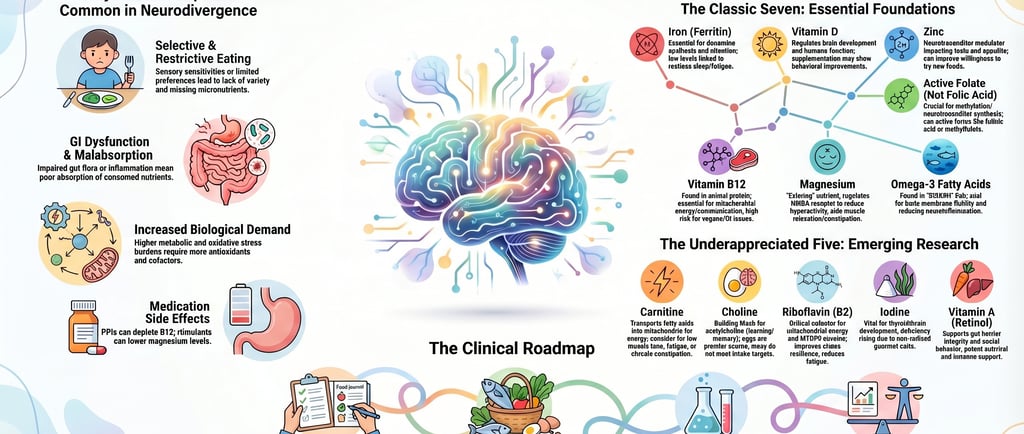
Many children with neurodevelopmental differences experience nutrient gaps not just because of what they eat, but because of why their bodies struggle to use it. Factors like selective or restrictive eating, GI inflammation, and the use of medications like PPIs (reflux meds)—which can deplete B12—create "functional gaps" that we can address through targeted support.
The Gut-Brain Dialogue
Direction of Communication
The Impact
Gut to Brain (90%)
Gut bacteria and the gut barrier influence neurotransmitter production, social behavior, and mental health.Brain to Gut (10%)
The brain coordinates the mechanics of digestion, though stress can disrupt nutrient absorption.
Because a healthy gut is necessary for producing brain chemicals, supporting the digestive tract is the first step toward mental clarity.
3. The Brain’s Essential Toolkit: Key Vitamins and Minerals
Vitamins and minerals act as the "tools" that keep our internal engines running. When these tools are missing, a child might feel restless, fatigued, or "stuck."
Iron: The Focus Builder
Biological Function: Necessary for synthesizing dopamine, the neurotransmitter responsible for motivation and reward.
How Deficiency Feels: Low ferritin (stored iron) can lead to fatigue, "restless" sleep, and trouble attending to tasks.
Power Benefit: Enhanced focus and better sleep quality.
Everyday Food Hero: Red meat or dark poultry. Expert Tip: Pair iron-rich foods with Vitamin C (like tomato sauce on meatballs) to boost absorption, and consider using cast-iron cookware.
Vitamin D: The Immune Guard
Biological Function: Regulates neuroimmune function and brain development pathways.
How Deficiency Feels: Mood imbalances or frequent illness.
Power Benefit: Robust immune support and behavior modulation.
Everyday Food Hero: Egg yolks and fatty fish. Expert Tip: Vitamin D is a team player; it is best utilized when paired with Magnesium and Vitamin K2.
Zinc: The Appetite Regulator
Biological Function: Modulates neurotransmitters and maintains the gut barrier. It also affects how we taste and smell food.
How Deficiency Feels: A lack of interest in eating or extreme "pickiness" (a common "chicken-and-egg" paradox).
Power Benefit: Improved appetite and cognitive ability.
Everyday Food Hero: Beef or pumpkin seeds. Expert Tip: Zinc is best taken between meals, but if it causes nausea, it’s okay to take it with food. Safety Note: Avoid long-term high-dose zinc without supervision, as it can lead to copper depletion.
Magnesium: The Calming Mineral
Biological Function: Supports the production of GABA, a calming neurotransmitter, and regulates the NMDA receptor to prevent "over-excitation" in the brain.
How Deficiency Feels: Anxiety, muscle tension, or difficulty falling asleep.
Power Benefit: Calming the nervous system and supporting bowel regularity.
Everyday Food Hero: Leafy greens and almonds. Expert Tip: Use Magnesium Glycinate for calming and Citrate if constipation is a primary concern.
4. Healthy Fats: Making Your Brain "Fluid" and Fast
The human brain is predominantly fat. To function optimally, it requires Omega-3 fatty acids to maintain "membrane fluidity." This fluidity is what allows brain cells (synapses) to talk to each other quickly and effectively. Omega-3s also act as powerful anti-inflammatories for the brain and body.
To find high-quality fish sources that are low in mercury but high in Omega-3s, remember the SMASH list:
Salmon
Mackerel
Anchovies
Sardines
Trout
Herring
5. The Superstars in Your Kitchen: Eggs, Greens, and More
We always lead with a "Food First" approach because whole foods contain a complex synergy of nutrients that supplements cannot fully replicate.
Eggs: A true "nutrient powerhouse" providing Choline (for memory), Vitamin A (for brain plasticity), and Iodine (for language and thyroid health).
Leafy Greens: These provide magnesium and—crucially—Folate.
The Functional Distinction: Always look for natural Folate or active forms like methylfolate or folinic acid. Avoid synthetic folic acid, which the body may struggle to convert. These active forms support Methylation, a vital process for detoxification and making new cells.
Legumes: Beans and lentils provide "resistant starches" that feed good gut bacteria.
Sensory Tip: If the texture of whole beans is a barrier, try serving them as hummus, roasted "crunchy" beans, or dal (a starchy, mild porridge).
Expert Tip: Food First Whole food is the ideal delivery system for nutrition. While targeted supplementation can bridge gaps—especially for selective eaters—the goal is to build a robust, nutrient-dense diet that allows the body to heal itself.
6. Your Pathway to Abundant Health
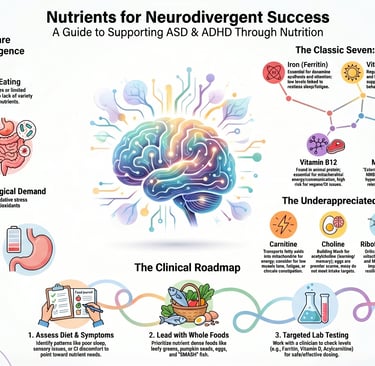
Improving your family's health is a journey where you are the driver. Think of me as your Health GPS: we identify the destination, and I provide the best route. We use a clinical cycle of Assess, Add, and Reassess.
Assess: Look at diet and symptoms like sleep, energy, or sensory overload.
Add: Incorporate whole foods and use targeted labs to check levels of iron, Vitamin D, or carnitine.
Reassess: Observe the shifts in behavior and "recalculate" as needed.
A Note on Safety: While food is our primary tool, safety is paramount. Fat-soluble vitamins (A and D) and Iron carry risks of toxicity if taken in excess. Always work with a clinician to monitor levels and ensure you are using medical-grade supplements that are tested for purity and quality.
Nutritional sufficiency is not about a "cure"; it is about providing the body with the materials it needs to function at its highest level. When we close these nutrient gaps, we allow every child to reach their fullest, most vibrant potential.